In Apache HTTP Server 2.4, mod_cache provides RFC 2616 compliant HTTP caching. Two key directives in the documentation govern request phase handling and backend concurrency: CacheQuickHandler and CacheLock. Understanding their documented behaviors allows administrators to choose when to bypass standard processing phases and when to serialize backend revalidations to protect origin servers.
CacheQuickHandler: Quick Handler vs Normal Handler Phase
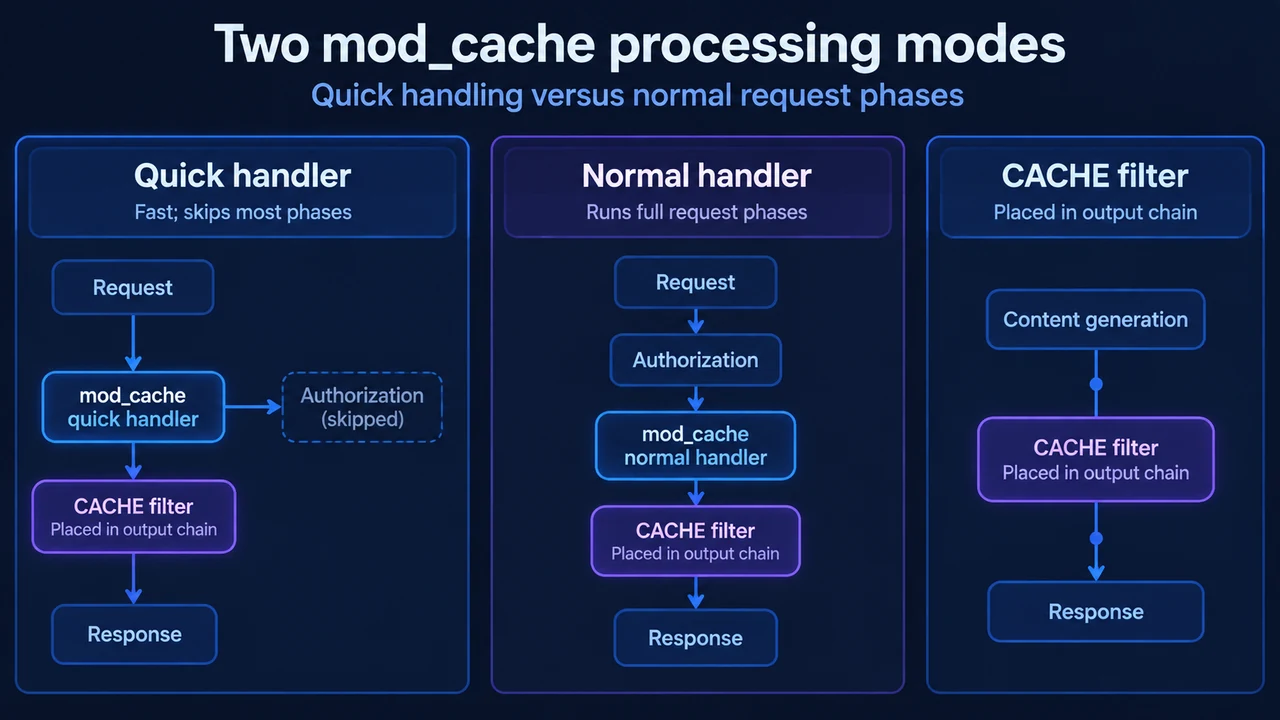
Under the default mode of operation, mod_cache runs inside the server’s quick handler phase. The documentation states that this phase short-circuits the majority of server processing and represents the most performant mode of operation for a typical server, acting as if a caching proxy server were bolted to the front of the web server.
Because running in the quick handler phase avoids the majority of server processing, it bypasses subsequent request handling phases. When content requires per-request processing or is subject to authorization, this mode prevents those checks from running on cached requests.
When an administrator sets CacheQuickHandler off, the cache operates as a normal handler. In normal handler mode, the request is subject to the full sequence of server request handling phases, allowing authentication and authorization checks to execute.
Controlling Filter Placement with the CACHE Filter
When CacheQuickHandler off is configured, administrators can insert the CACHE filter at a chosen location in the output filter chain. This allows caching unpersonalized or uncompressed content prior to downstream transformations.
For example, the documentation illustrates placing the CACHE filter before server-side includes and compression:
# Run cache as a normal handler
CacheQuickHandler off

# Cache content before mod_include and mod_deflate
AddOutputFilterByType CACHE;INCLUDES;DEFLATE text/html
In this sequence, content is cached before mod_include parses tags or applies personalization and before mod_deflate applies compression. The documentation notes that if the CACHE filter is specified more than once in the filter chain, the last instance applies. Additionally, if the location of the CACHE filter in the filter chain is changed, the administrator may need to flush the cache to maintain consistent data.
CacheLock: Mitigating the Thundering Herd During Revalidation
When a cached entry becomes stale, mod_cache sends a conditional request to the backend server to confirm whether the cached entry is still fresh and receive an updated entity if not. A small but finite amount of time elapses between when an entry becomes stale and when the revalidation completes.
The CacheLock directive addresses this window:
- When
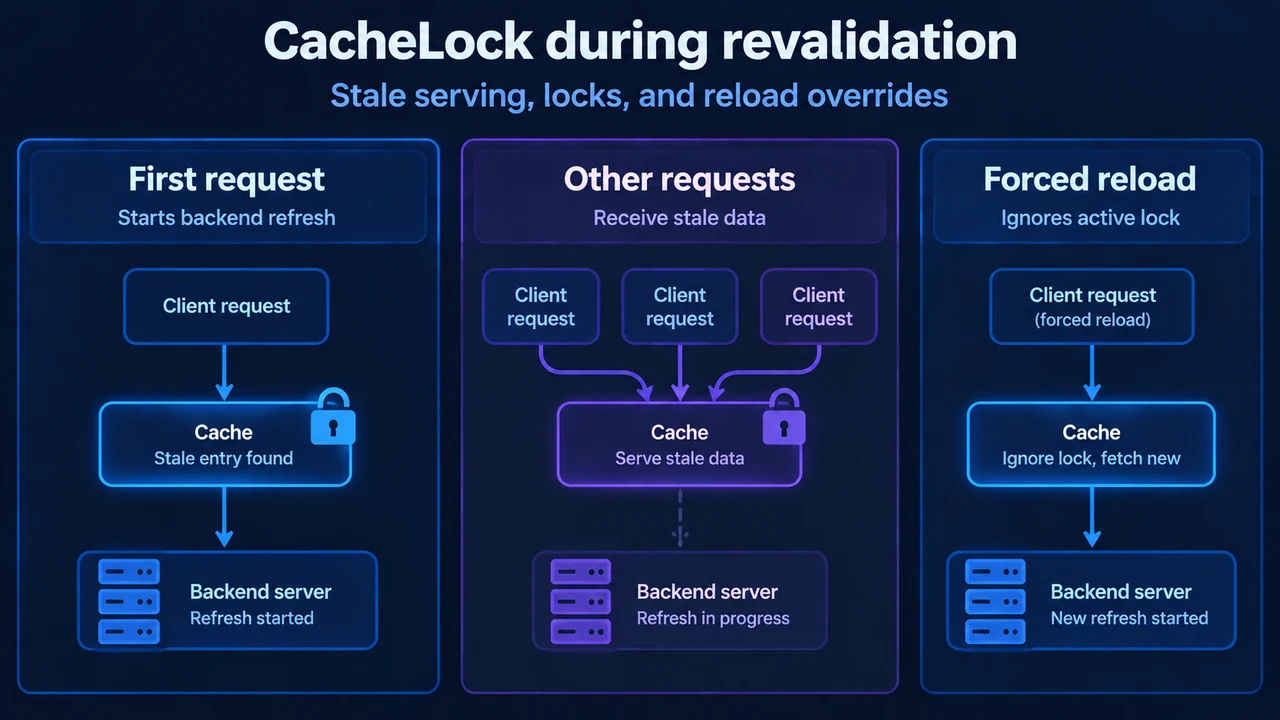
CacheLockis suitably configured and active, a lock is acquired during revalidation. - During the lifetime of the lock, the second and subsequent incoming requests return stale cached data instead of contacting the backend, keeping the thundering herd at bay.
- Under RFC 2616, responses returning stale data while an existing stale entry is refreshed include a
WarningHTTP header with a110response code.
CacheLock Configuration, Timeouts, and Client Overrides
Apache documentation provides directives to configure lock storage and maximum lock duration:
<IfModule mod_cache.c>
    CacheLock on
    CacheLockPath "/tmp/mod_cache-lock"
    CacheLockMaxAge 5
</IfModule>
The CacheLockPath directive specifies the path where lock files are located. CacheLockMaxAge sets the maximum age for a lock in seconds and defaults to 5 seconds. Once this maximum age is reached, the lock is removed, allowing a new request to create a lock if refreshing has not completed.
Documented operational boundaries include:
- Locks are hints: Locks are used as hints to enable the cache to be more gentle on backend servers.
- Client override: If a client sends a request with a
Cache-Controlheader forcing a reload (such asno-cache), any active lock is ignored, the client’s request is honored immediately, and the cached entry is refreshed. - Stale on error: By default in
mod_cache, when an attempt to refresh stale data returns an HTTP status code of 500 or above, the cache returns stale data accompanied by aWarningHTTP header with a111response code (governed byCacheStaleOnError, which defaults toon).
Operational Roles: CacheQuickHandler vs CacheLock
CacheQuickHandler and CacheLock govern distinct stages of cache handling in mod_cache:
- CacheQuickHandler controls the server execution phase (quick handler vs normal handler). Running as a quick handler provides maximum performance but avoids authorization and filter manipulation; disabling it routes requests through standard authentication, authorization, and custom
CACHEfilter positions. - CacheLock manages concurrent backend revalidation when cached entries become stale. When configured, it serves stale data with a 110 Warning header to concurrent requests during the lock window, while respecting client reload overrides.
Research Method and Limitations
This technical explainer was prepared solely using the provided public documentation excerpts from the Apache HTTP Server Version 2.4 mod_cache manual and public tutorial coverage from DigitalOcean. Competing coverage from DigitalOcean was unavailable in detail because the retrieved excerpt contained only general site portal text. In addition, the supplied Apache documentation contains truncated sections, omitting full directive syntax tables, directive-scope details, and explicit default settings for directives such as CacheLock and CacheLockPath. No live server benchmarks, performance tests, or hands-on environments were evaluated.
Text version of the diagrams
- Two mod_cache processing modes: Quick handler — Fast; skips most phases; Normal handler — Runs full request phases; CACHE filter — Placed in output chain
- CacheLock during revalidation: First request — Starts backend refresh; Other requests — Receive stale data; Forced reload — Ignores active lock