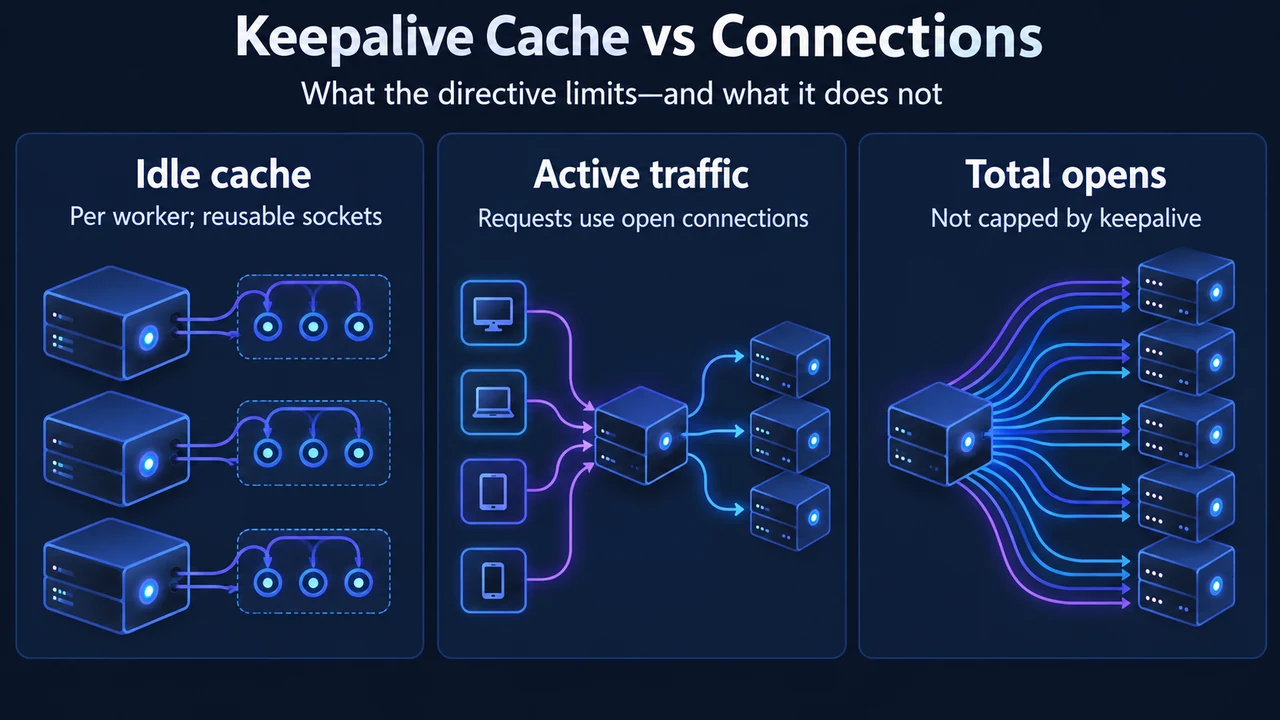
In Nginx, the keepalive directive configures caching of keepalive connections to upstream servers. Each worker process preserves a configured number of idle keepalive connections in its cache rather than opening a new connection for each proxied request.
Upstream Keepalive Directive and Version Defaults
The keepalive directive is configured within the upstream block. It sets the maximum number of idle keepalive connections to upstream servers preserved in the cache of each worker process. Setting this parameter to zero disables keepalive connections to upstream servers.
The keepalive directive does not limit the total number of connections to upstream servers that an Nginx worker process can open. The documentation states that the connections parameter should be set to a number small enough to let upstream servers process new incoming connections as well.
Starting in version 1.29.7, keepalive connections are enabled by default, with a default limit of 32 connections per worker process. Before version 1.29.7, when using load balancing methods other than the default round-robin method, it was necessary to activate those methods before the keepalive directive.
Cross-Location Sharing and the local Parameter
The documentation defines specific behavior for sharing keepalive connections across different locations:
- The
localparameter (introduced in version 1.29.7) disables sharing of cached keepalive connections across different locations even if the upstream server address matches. - If the
localparameter is not specified, any matching cached connection to the same upstream server can be reused regardless of location.
Protocol and Header Requirements
The documentation specifies distinct configuration rules for upstream protocols:
- HTTP: The
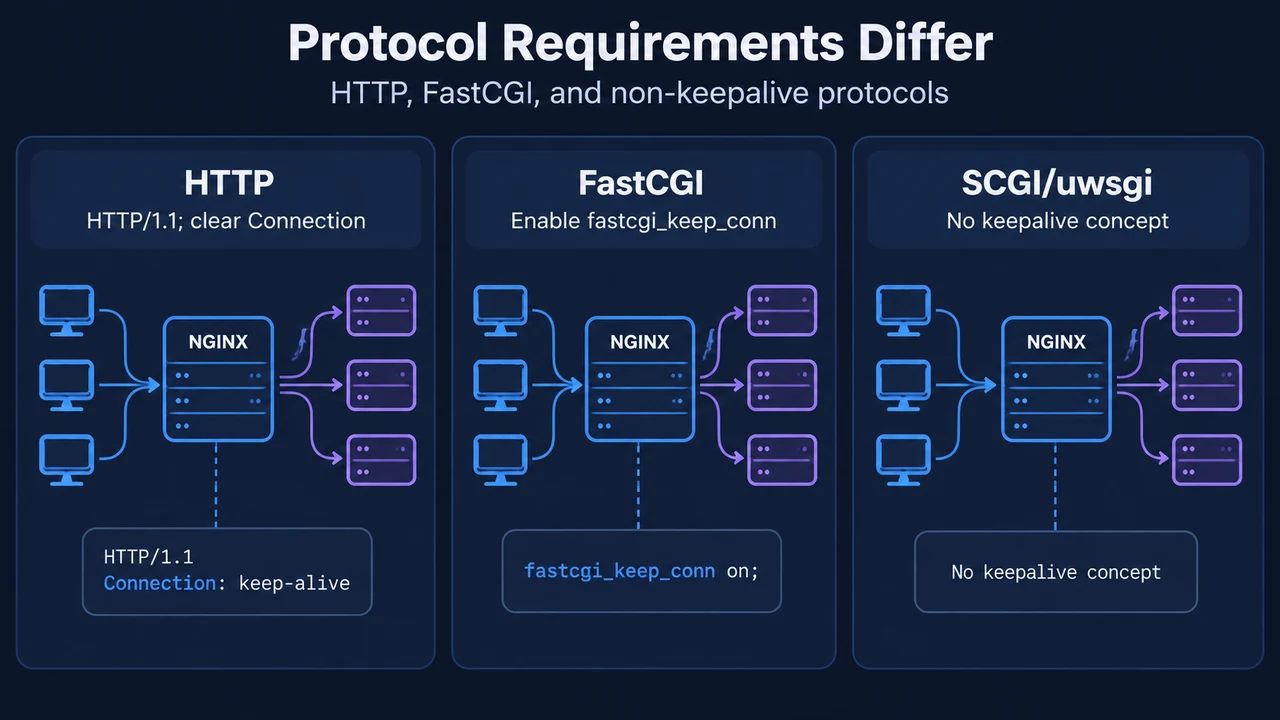
proxy_http_versiondirective should be1.1(the default since version 1.29.7) or set to2, and theConnectionheader field should be cleared. Alternatively, HTTP/1.0 persistent connections can be used by passing theConnection: Keep-Aliveheader field to an upstream server, though this method is not recommended. - FastCGI: Keepalive connections require setting
fastcgi_keep_conn on;in the location block. - SCGI and uwsgi: These protocols do not have a notion of keepalive connections.
- memcached: Upstream keepalive caching can be configured with
memcached_passand thekeepalivedirective in the upstream block.
Cache Behavior and Server Limits
Cached keepalive connections are maintained per worker process. When the configured idle connection count is exceeded, Nginx closes the least recently used connections.
When the max_conns parameter is configured on an upstream server, it limits the maximum number of simultaneous active connections to that server. If the server group does not reside in shared memory, the limitation operates per worker process. If idle keepalive connections, multiple workers, and shared memory are enabled, the total number of active and idle connections to the proxied server may exceed the max_conns value.
Keepalive Lifecycle Directives
The ngx_http_upstream_module provides three directives within the upstream context to control keepalive connection lifecycles:
| Directive | Default | Introduced | Documented Behavior |
|---|---|---|---|
keepalive_requests |
1000 (was 100 before 1.19.10) |
1.15.3 | Sets the maximum number of requests served through one keepalive connection. After this count is reached, the connection is closed. Closing connections periodically is necessary to free per-connection memory allocations; using too high a limit could result in excessive memory usage and is not recommended. |
keepalive_time |
1h |
1.19.10 | Limits the maximum time during which requests can be processed through one keepalive connection. After this time is reached, the connection is closed following subsequent request processing. |
keepalive_timeout |
60s |
1.15.3 | Sets a timeout during which an idle keepalive connection to an upstream server will stay open in the cache. |
Documented Configuration Examples
For HTTP proxying prior to version 1.29.7, documentation outlines configuring the upstream block with keepalive and explicitly configuring the location:
upstream http_backend {
    server 127.0.0.1:8080;
    keepalive 16;
}

server {
    ...
    location /http/ {
        proxy_pass http://http_backend;
        proxy_http_version 1.1; # before version 1.29.7
        proxy_set_header Connection ""; # before version 1.29.7
        ...
    }
}
For FastCGI upstream servers, fastcgi_keep_conn is required:
upstream fastcgi_backend {
    server 127.0.0.1:9000;
    keepalive 8;
}

server {
    ...
    location /fastcgi/ {
        fastcgi_pass fastcgi_backend;
        fastcgi_keep_conn on;
        ...
    }
}
For memcached upstream servers, keepalive connections can be defined as follows:
upstream memcached_backend {
    server 127.0.0.1:11211;
    server 10.0.0.2:11211;
    keepalive 32;
}

server {
    ...
    location /memcached/ {
        set $memcached_key $uri;
        memcached_pass memcached_backend;
    }
}
Research Method and Limitations
This technical summary was prepared exclusively from the supplied public source excerpts of the official Nginx ngx_http_upstream_module documentation. The supplied source text is truncated, omitting competing coverage and leaving aspects of connection handling outside the visible excerpts unverified. No hands-on testing, benchmarks, or independent runtime observations were conducted.
Text version of the diagrams
- Keepalive Cache vs Connections: Idle cache — Per worker; reusable sockets; Active traffic — Requests use open connections; Total opens — Not capped by keepalive
- Protocol Requirements Differ: HTTP — HTTP/1.1; clear Connection; FastCGI — Enable fastcgi_keep_conn; SCGI/uwsgi — No keepalive concept