Understanding Cloudflare Edge Traffic Control
Cloudflare provides multiple features within its Rules suite to adjust traffic across its network. Two mechanisms for request and response modification are Transform Rules and Snippets. While both allow administrators to alter traffic, they serve distinct roles, run at different points in the Cloudflare Rules execution pipeline, and operate under different resource limits and plan requirements.
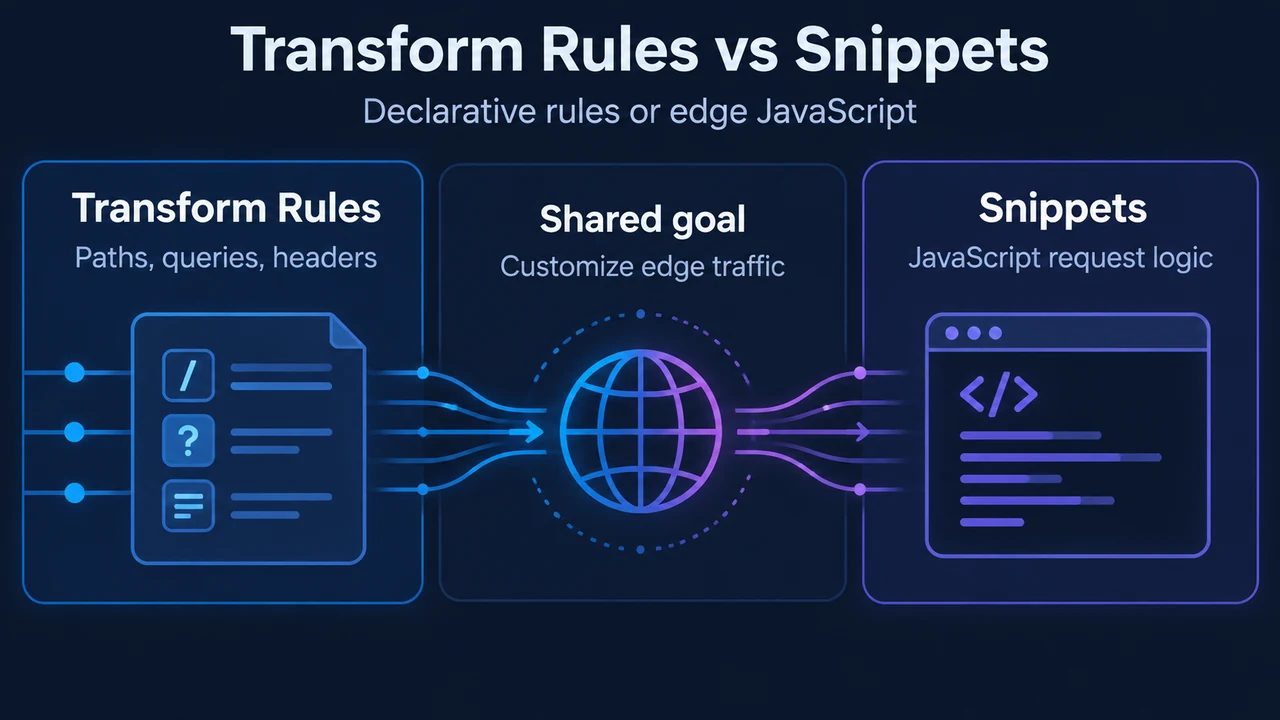
According to Cloudflare Transform Rules documentation, Transform Rules adjust the URI path, query string, and HTTP headers of requests and responses. In contrast, Cloudflare Snippets documentation defines Snippets as short pieces of JavaScript code executed directly on Cloudflare’s network to handle custom request and response logic, such as modifying HTTP response headers, implementing JWT validation, and performing complex redirects.
Feature Comparison and Resource Limits
Transform Rules provide configuration-based adjustments, whereas Snippets execute JavaScript edge code. The documented limits and plan availability between both features differ as follows:
| Dimension | Transform Rules | Cloudflare Snippets |
|---|---|---|
| Core Mechanism | URL Rewrite Rules, Request Header Transform Rules, Response Header Transform Rules, and Managed Transforms | JavaScript code associated with a single filter expression (Snippet rule) |
| Plan Availability | Free, Pro, Business, and Enterprise | Pro, Business, and Enterprise (Unavailable on Free: 0 snippets) |
| Active Rules / Snippet Allocation | Free: 10 Pro: 25 Business: 50 Enterprise: 300 |
Free: 0 Pro: 25 Business: 50 Enterprise: 300 |
| Snippet Subrequest Limits | Not documented in the Transform Rules excerpt | Free: 0 Pro: 2 Business: 3 Enterprise: 5 |
| Execution Constraints | Evaluates within the declarative rules engine; specific memory or CPU limits are not documented in the Transform Rules excerpt | All plans: Maximum 5 ms execution time, 2 MB memory, and 32 KB total package size |
| Regular Expression Support | Business and Enterprise plans only (No regex on Free or Pro) | JavaScript execution environment; specific regex plan tiers are not separately documented in the Snippets excerpt |
| Version Management Support | Not documented in the Transform Rules excerpt | Currently, Version Management does not support Snippets |
| Access Permissions | Requires the Firewall role or one of the Administrator roles | Not documented in the Snippets excerpt |
Ruleset Pipeline and Execution Order
Understanding the exact execution phase is essential when configuring traffic rules. The Cloudflare Ruleset Engine evaluates rules in the following documented sequence:
- Single Redirects
- URL Rewrite Rules
- Configuration Rules
- Origin Rules
- Bulk Redirects
- Managed Transforms
- Request Header Transform Rules
- Cache Rules
- Snippets
- Cloud Connector
This sequence outlines the documented order between these features:
- URL Rewrite Rules and Request Header Transform Rules execute before Snippets: URL Rewrite Rules execute in step 2, Managed Transforms run in step 6, and Request Header Transform Rules run in step 7, all preceding Snippets in step 9.
- Snippets execute after Cache Rules: Snippets evaluate at step 9, after Cache Rules in step 8.
- Precedence over Page Rules: The listed Rules products take precedence over Page Rules. If a request matches both a Page Rule and any of the modern Rules features listed, Page Rules are overridden.
Evaluation Semantics and Operational Rules
Cloudflare documents specific evaluation behaviors across its Rules products:
Non-Terminating Actions
For non-terminating actions—such as modifying HTTP headers—the last change made by rules in the same phase will win. Later rules can overwrite changes done by previous rules. In Transform Rules, administrators can define the rule order in the dashboard or via API.
Terminating Actions
For terminating actions (Block, Redirect, or one of the challenge actions), rule evaluation stops and the action executes immediately. For example, if multiple rules with the Redirect action match, Cloudflare always uses the URL redirect of the first rule that matches. Furthermore, if URL redirects are configured using different products, the product executed first applies if there is a match (for instance, Single Redirects executes before Bulk Redirects).
Field Immutability Within Transform Phases
Request and response fields are immutable within each phase while evaluating Transform Rules. This means that later rules in the same phase cannot match on changes made by earlier rules; they always evaluate against the original field values.
Subrequest Accounting in Snippets
For Snippets that issue subrequests, each subrequest in a redirect chain counts against the subrequest limit. If a subrequest is redirected, it counts as two subrequests against the plan allowance (for example, out of 2 on Pro or 3 on Business). To avoid issues, Cloudflare advises making subrequests directly to the end location of the redirect chain.
Choosing Between Transform Rules and Snippets
Selection between Transform Rules and Snippets depends on the required action, plan availability, and documented capabilities:
When to Use Transform Rules
- URL Path and Query Rewriting: Rewriting the URL path and query string of an HTTP request using URL Rewrite Rules.
- Standard Header Operations: Setting or removing HTTP request headers using Request Header Transform Rules, or setting or removing HTTP response headers using Response Header Transform Rules.
- Managed Transforms: Performing common adjustments to HTTP request and response headers using pre-built, one-step configurations. Managed Transforms adjusting request headers run before Request Header Transform Rules, and those adjusting response headers run before Response Header Transform Rules.
- Free Plan Compatibility: Setting up declarative rules on Free plans, which support up to 10 active Transform Rules without regular expressions.
When to Use Snippets
- JavaScript-Based Request and Response Customization: Running short pieces of JavaScript code on Cloudflare’s network to customize how requests and responses are handled.
- Documented Snippet Use Cases: Modifying HTTP response headers, implementing JWT validation, or performing complex redirects beyond declarative rules.
- Paid Plan Requirements: Running custom logic on Pro (up to 25 snippets, 2 subrequests), Business (50 snippets, 3 subrequests), or Enterprise (300 snippets, 5 subrequests) plans within the 5 ms maximum execution time, 2 MB maximum memory, and 32 KB total package size limits.
Troubleshooting Transform Rules
When troubleshooting Transform Rules, Cloudflare documentation specifies using Cloudflare Trace to determine if a rule is triggering for a specific URL.
Text version of the diagrams
- Transform Rules vs Snippets: Transform Rules — Paths, queries, headers; Shared goal — Customize edge traffic; Snippets — JavaScript request logic
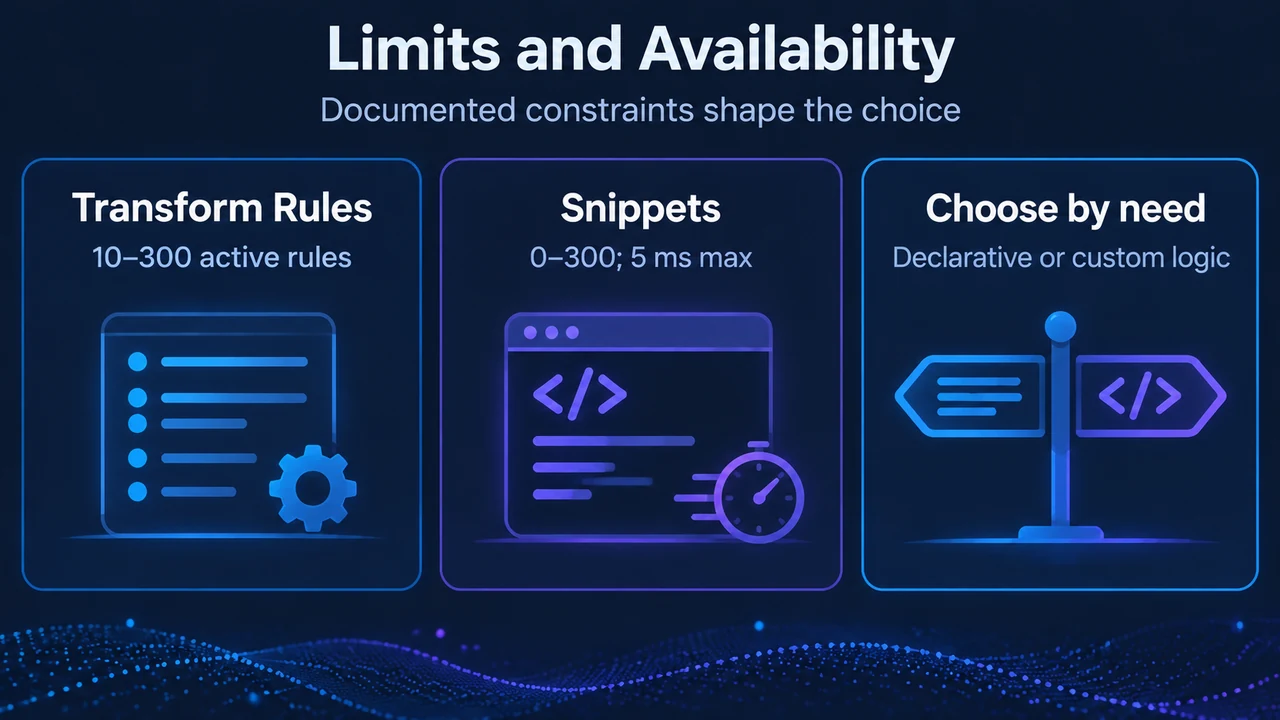
- Limits and Availability: Transform Rules — 10–300 active rules; Snippets — 0–300; 5 ms max; Choose by need — Declarative or custom logic
Research Methodology and Limitations
This comparative guide was prepared entirely from the supplied public documentation excerpts for Cloudflare Snippets and Transform Rules, both bearing the last-updated date of August 14, 2026. Material limitations include the absence of competing third-party coverage for comparison, and that neither excerpt provides detailed subrequest limits for Transform Rules, access permission roles for Snippets, or operational details for Cloudflare Trace beyond checking whether a rule triggers for a specific URL. Unseen platform behavior cannot be inferred.