API Architecture: WordPress REST API vs. Strapi Content API
External applications consume structured content through programmatic application programming interfaces (APIs). The general WordPress REST API documentation and the Strapi 5 Content API documentation specify distinct exposure surfaces and internal query layers.
According to the general WordPress REST API Handbook (updated January 16, 2024, without a specific WordPress version scope), the WordPress REST API provides an interface for applications to interact with a WordPress site by sending and receiving data as JSON objects. It exposes REST endpoints representing built-in data types, such as posts, pages, and taxonomies. Content that is public on a WordPress site is generally publicly accessible via the REST API. Private content, password-protected content, internal users, custom post types, and metadata require authentication or specific visibility configuration.
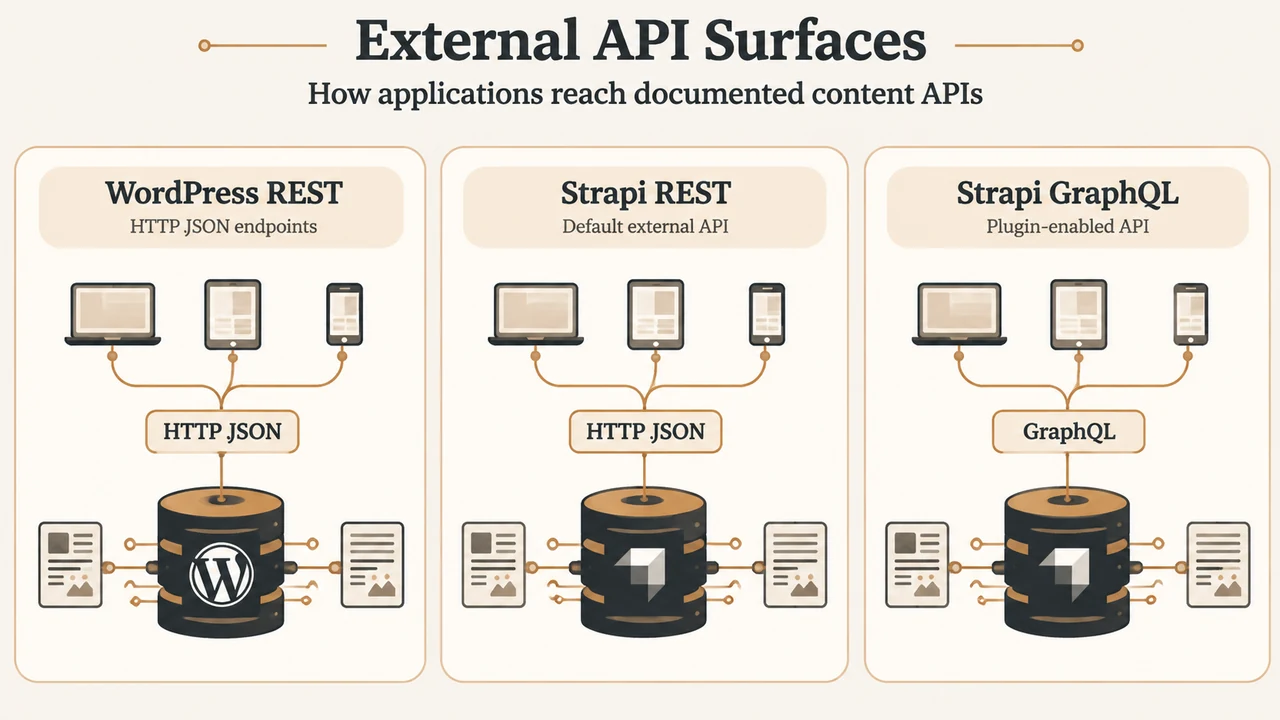
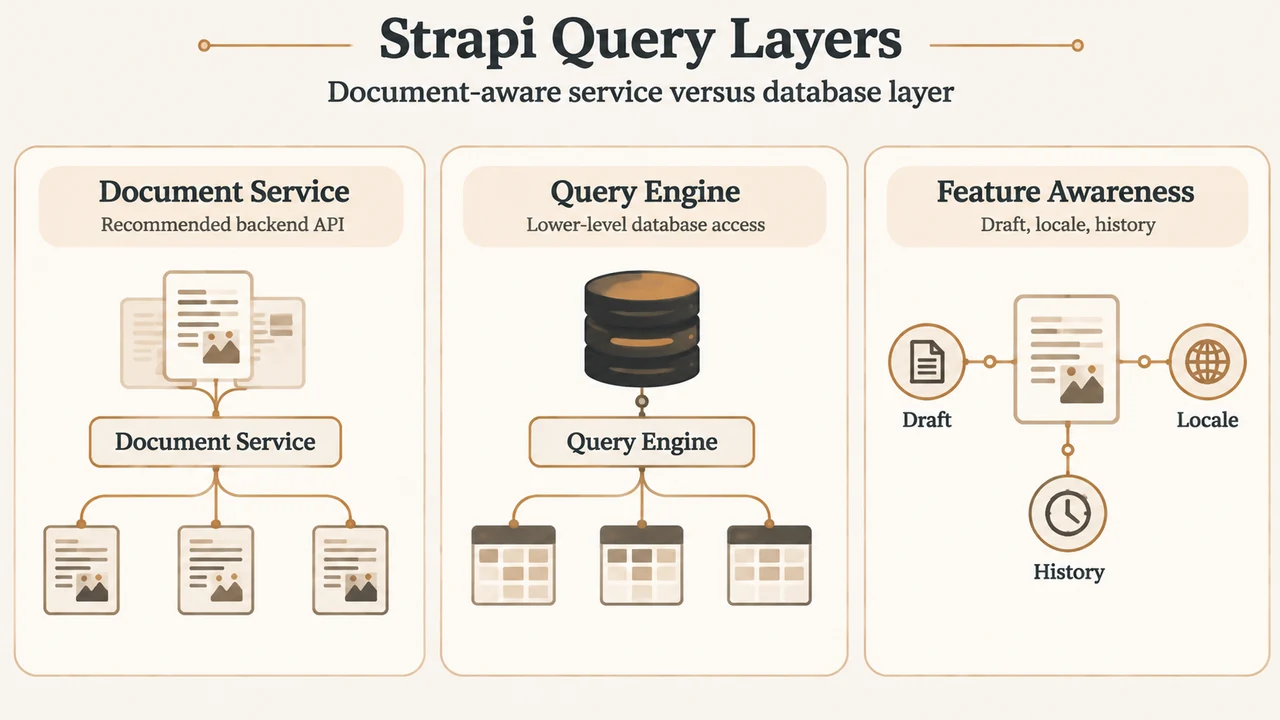
According to the Strapi Content API documentation, Strapi provides front-end applications access to content through its Content API. This interface is exposed by default through a REST API, and through a GraphQL API if the built-in GraphQL plugin is installed. Internally, Strapi 5 defines two lower-level APIs for backend server code and plugins:
- Document Service API (
strapi.documents): The recommended API for interacting with the database from the backend server or plugins. In Strapi 5, it manages documents—representing content variations across locales and draft/published versions—along with complex structures like components and dynamic zones. - Query Engine API (
strapi.db.query): A lower-level interface used under the hood to execute database queries with unrestricted internal database access. It is not aware of advanced Strapi 5 features such as Draft & Publish, Internationalization, or Content History. Strapi recommends using the Document Service API for most, if not all, use cases.
Client Integration and Exposure Boundaries
The WordPress REST API supports interaction from any programming language capable of sending HTTP requests and parsing JSON, explicitly including PHP, Node.js, Go, Java, Swift, Kotlin, and client-side JavaScript. The REST API also serves as the foundation for the WordPress Block Editor.
For Strapi, front-end applications interact with the Content API via REST queries, GraphQL queries (when the GraphQL plugin is installed), or the Strapi Client library. For custom server logic or plugin development, developers query data using the Document Service API (strapi.documents) or the Query Engine API (strapi.db.query).
Architectural Comparison
| Dimension | WordPress REST API | Strapi Content API |
|---|---|---|
| External Query Protocols | REST over HTTP delivering JSON objects | REST over HTTP by default; GraphQL via built-in plugin |
| Client Integration Options | HTTP/JSON requests from any language (e.g., PHP, Node.js, Go, Java, Swift, Kotlin, JavaScript) | REST requests, GraphQL requests, and the Strapi Client library |
| Internal Backend Query Layers | Not detailed in the provided REST API Handbook overview excerpt | Document Service API (strapi.documents) and Query Engine API (strapi.db.query) |
| Core Native Data Concepts | Posts, pages, taxonomies, custom post types, internal users, metadata | Documents (locales, draft/published versions), components, dynamic zones |
| Access Boundaries | Public site content is generally publicly accessible; private items, protected items, internal users, custom types, and metadata require authentication or configuration | Not detailed in the provided Content API overview excerpt |
| Documentation and Version Scope | General WordPress REST API Handbook (last updated January 16, 2024; version unstated) | Strapi 5 documentation for Content API, Document Service API, and Query Engine API |
Text version of the diagrams
- External API Surfaces: WordPress REST — HTTP JSON endpoints; Strapi REST — Default external API; Strapi GraphQL — Plugin-enabled API
- Strapi Query Layers: Document Service — Recommended backend API; Query Engine — Lower-level database access; Feature Awareness — Draft, locale, history
Research Methodology and Limitations
This comparison was prepared exclusively from the supplied public documentation excerpts: the WordPress REST API Handbook (developer.wordpress.org, last updated January 16, 2024) and the Strapi Content API documentation (docs.strapi.io). No competing coverage was accessible. The analysis is limited to the API endpoints, client interfaces, and internal query mechanisms documented in the visible excerpts. The WordPress excerpt provides general documentation without specifying a concrete WordPress version number or internal query layers, whereas Strapi internal-layer mechanisms explicitly reference Strapi 5. End-to-end delivery mechanics, hosting runtimes, and detailed access permission configurations were not detailed in the visible excerpts and are omitted.